
Featured Popular
TikTok Slang in 2026: 18 Words and Phrases Explained
by
Oxford International
Published on
TikTok slang can be confusing when you’re learning English. For example, familiar words like “cooked” can have a different meaning online.
This guide explains 18 TikTok slang words and phrases for 2026. You’ll find simple meanings, examples and advice on when to use them.

TikTok slang is informal language used in videos, captions and comments. It includes abbreviations, expressions of praise, jokes and references to internet trends.
Many expressions existed before TikTok. For example, the complimentary uses of “ate” and “slay” developed in Black and Latino LGBTQ+ ballroom communities before spreading more widely online.
Meanings can also change between communities and situations. A phrase might be sincere in one video and sarcastic in another. Pay attention to the speaker’s tone, the video and the surrounding comments.
Here are the most 2026 words we incorporate on our day because they became popular on TikTok.
POV stands for “point of view.” It refers to someone’s perspective or experience.
On TikTok, creators often use it to introduce a situation for viewers to imagine themselves in. The video may recreate a familiar experience, such as meeting new classmates or preparing for an exam.
Example: “POV: It’s your first day at an English school abroad.”
Here, the creator is inviting you to imagine that situation.
FYP stands for “For You Page.” This is TikTok’s personalised feed of recommended content. You will also see it called the “For You feed.”
Example: “My FYP is full of videos about student life.”
Creators sometimes add #FYP to their captions. However, using that hashtag does not guarantee that a video will appear in someone’s recommendations. TikTok explains that it works like other hashtags.
Calling someone the “CEO of” something is a playful way to say they are especially good at it. The abbreviation still stands for “chief executive officer,” but the slang expression does not refer to a real job title.
Example: “She’s the CEO of video editing.”
This means her editing skills are impressive. You might see the phrase in comments praising a creator’s talent.
OOMF means “one of my followers” or “one of my friends.” It lets someone refer to another person without naming them.
Example: “OOMF just moved to Toronto.”
The abbreviation itself is not necessarily negative. The rest of the sentence tells you whether the person is sharing news, making a joke or expressing frustration.
You may also see it written in lowercase as “oomf.”
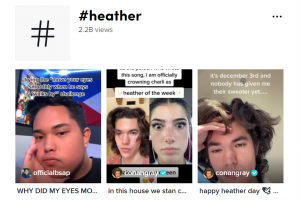
TikTok users have added many new words to Urban Dictionary. There is a new term that has been going viral in the past year: Heather. Until 2021, there are over 2.2B views on this hashtag.
Heather was created by Conan Gray, a popular song on TikTok. Conan sings about the all-too-common scenario in which the person you have a crush on has a crush on someone else in the song.
Urban Dictionary defines the term as “When someone says that you are Heather, they mean that everyone can’t help but like you.”
Enhance Your English Skills with Oxford International
Learn MoreRizz means charm, especially the ability to attract someone’s romantic interest. It can describe someone who is confident and effective at flirting.
Example: “He has so much rizz.”
You may also see “rizz up” used as a verb, meaning to charm or flirt with someone. This is casual language for social conversations, rather than formal writing.
Delulu is a shortened form of “delusional.” Online, it often describes unrealistic expectations or exaggerated confidence, sometimes in a playful way.
Example: “I thought I’d become fluent after one lesson. That was delulu.”
Someone might use it to laugh at their own expectations. Calling another person delulu can sound dismissive, so pay attention to the relationship and tone.
“Ate” means someone did something impressively well. “Ate and left no crumbs” strengthens the compliment, suggesting that the result was excellent.
Example: “That final dance routine? They ate and left no crumbs.”
In this context, the phrase has nothing to do with food. You might see it used to praise a performance, an outfit or a creative achievement.
Slay means to do something exceptionally well or make an impressive appearance. It is often used as an enthusiastic compliment.
Example: “You slayed that presentation.”
Someone might also comment “Slay!” to show support or admiration. The literal meaning of “slay” is very different, which makes this a useful example of why context matters when learning slang.
Aura describes someone’s coolness, confidence or impressive presence. “Aura points” are imaginary points that someone gains or loses by doing something impressive or embarrassing.
Example: “You caught your phone before it hit the floor. Plus 100 aura points.”
There is no real scoring system. The numbers are part of the joke and are often deliberately exaggerated.
Aura farming means doing something to appear effortlessly cool or impressive. It might describe a confident pose, a dramatic entrance or a stylish moment captured on camera.
Example: “That slow walk towards the camera is pure aura farming.”
The phrase can be admiring or teasing. Watch the video and read the surrounding comments to understand how it is being used.
Cooked means being in trouble, facing failure or feeling that a situation has gone badly. People often use it dramatically for humorous effect.
Example: “My phone is on 1%, and I left my charger at home. I’m cooked.”
The speaker is describing a difficult situation. In another video, “we’re cooked” might express a group’s worry about what will happen next.
Mid means average, disappointing or less impressive than expected. It is usually a criticism rather than a compliment.
Example: “Everyone loved the film, but I thought it was mid.”
The speaker feels that the film did not deserve all the praise. Calling someone’s work “mid” can sound dismissive, especially if you do not know them well.
Lore means the background story or history of a person, character or fictional world. On social media, people also use it humorously for details about their own lives.
Example: “You used to live in Japan? I need the lore.”
Here, the speaker wants to hear the story. “New lore” can refer to something surprising you have just discovered about someone.
A canon event is an experience that helps shape someone’s life or identity. Online, the phrase often describes a relatable or embarrassing experience as part of growing up.
Example: “Getting lost on your first day abroad is a canon event.”
The speaker is treating an ordinary experience like a meaningful moment in a character’s story. The expression is often playful.
Rage bait is content designed to make people angry and provoke a reaction. The aim may be to attract attention, comments or clicks.
Example: “That post is rage bait. They want people to argue.”
Understanding this phrase can help you follow discussions about online content. It describes the suspected intention behind a post, rather than simply saying that the post is annoying.
Brain rot, also written as “brainrot,” can refer to repetitive or low-quality online content and becoming absorbed in it. People often use it jokingly when talking about memes or internet habits.
Example: “I’ve watched so many of those memes that I’ve got brainrot.”
The phrase can also describe content that makes little sense unless you already know the joke.
“Six seven” is a meme expression without one fixed meaning. It is often used as a shared joke, particularly when someone hears or sees the numbers six and seven.
Example: A creator mentions “page 67,” and the comments repeat “six seven.”
If you cannot find a clear translation, you are not missing an obvious definition. Recognising the reference is often the point of using it.
A pick-me is someone perceived as trying too hard to gain attention or approval. The expression “pick-me girl” often criticises someone for putting other women down to gain approval from men.
Example: “People called the character a pick-me because she kept putting other girls down.”
This is a critical label and can be insulting or unfairly applied. It is useful to recognise its meaning when reading comments.
TikTok slang usually belongs in casual conversations, messages and social media comments. For formal writing, choose words that clearly communicate your meaning to a wider audience.
These alternatives can help you move between informal and more neutral English:
| Informal expression | More neutral alternative |
|---|---|
| “You slayed that presentation.” | “You gave an excellent presentation.” |
| “That film was mid.” | “I found that film disappointing.” |
| “I’m cooked.” | “I’m in a difficult situation.” |
| “I need the lore.” | “I’d like to hear the background story.” |
Before using a new expression, listen to how other people use it. A joke may sound friendly between close friends. However, the same words can sound rude to someone you’ve just met.
You can also explore our guide to British slang to learn expressions you may hear while studying in the UK.

Use short videos to explore vocabulary in context. To get started, try these steps:
Once you understand the meaning, write your own example. Then, express the same idea in more neutral language. This way, you can practise choosing words for different audiences.
There is some overlap, but the labels have different meanings. TikTok slang refers to language used on the platform, while Gen Z slang describes expressions linked to that generation. However, many of these expressions are also used by other age groups and online communities.
Use clear, standard English in formal essays unless the task asks you to discuss informal language. In speaking tasks, choose expressions that suit the question and situation. Your teacher can also help you decide whether a particular phrase is appropriate.
People use “shadowban” when they believe a platform has reduced their content’s visibility without explaining why. However, low views alone do not establish the cause. TikTok also explains that some posts or accounts may not qualify for recommendations. For details, read its Help Centre guide to account recommendation restrictions.
Some expressions refer to a video, sound or shared joke. For example, “six seven” does not have one fixed meaning. Instead, people may use it to show that they recognise the reference.
Learning TikTok slang can help you follow online conversations. It can also make jokes and comments easier to understand. However, knowing when to use each expression matters too.
At Oxford International, our General English courses help you improve your English through practical lessons. You’ll practise with teachers and classmates. Our social programme also gives you time to speak English with new friends outside lessons.
Ready to build your confidence speaking English? Enquire today to find the right course for you.
>>> Read this article to learn more about British slang.
Published on – 22th October 2026

The Oxford International English Schools Team
The OI English Schools Team brings together experienced educators, academic leaders, global learning specialists, and marketing team specialists dedicated to helping students achieve language excellence across our 9 global English Schools in the UK, Canada, the USA, and Australia. With over 34 years of English language education expertise, supporting 317,000+ students worldwide, our mission is to help students learn English with confidence through innovative, real-world learning experiences and cultural immersion that empower our learners to achieve their dreams.